
Engineered for global brand scalability, high pigment fidelity, and multi-climate stability. Explore our leading private label liquid foundation lines available for low MOQ custom OEM manufacturing.
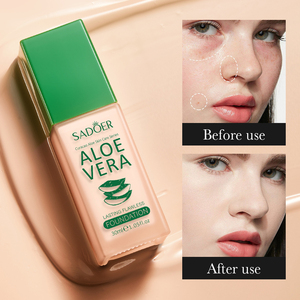
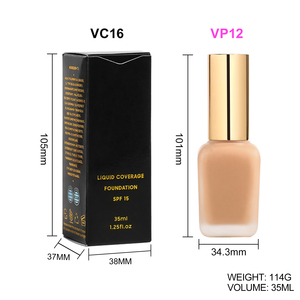
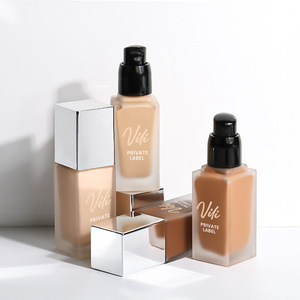
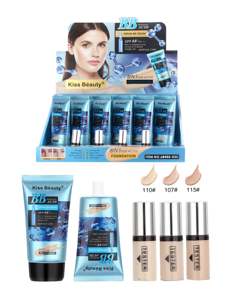
Backing your beauty brand with over 26 years of contract manufacturing experience, state-of-the-art R&D laboratories, and global compliance certifications.
Over 20 seasoned cosmetic formulation chemists driving innovation in micro-emulsion technology, pigment dispersion, and clean botanical stabilization.
Class 100,000 cleanrooms and stringent QA/QC protocols guarantee zero microbial contamination and perfect batch-to-batch color matching.
Seamless international shipping compliance with turnkey documentation including COA, MSDS, CPNP portal registration, and US FDA filings.
Dedicated Halal-certified manufacturing lines producing cruelty-free, vegan, alcohol-free, and paraben-free color cosmetics for sensitive markets.
The global color cosmetics market is undergoing a seismic paradigm shift driven by evolving consumer expectations, stringent regulatory standards, and breakthroughs in green chemistry. Modern beauty consumers no longer accept cosmetic products that merely provide aesthetic coverage; they demand multi-functional hybrid formulas that actively improve skin health while providing long-lasting, climate-adaptive wear. For global cosmetic brand owners, indie beauty founders, and enterprise beauty importers, navigating the supply chain complexities of liquid foundation OEM/ODM manufacturing in China requires a deep understanding of cosmetic chemistry, quality control paradigms, and emerging procurement trends.
As a leading Chinese custom cosmetics formulation manufacturer and exporter, our facility bridges the gap between scientific innovation and mass-market scalability. This white paper serves as an authoritative guide on liquid foundation formulation architecture, raw material selection, dynamic OEM/ODM procurement strategies, and global regulatory compliance frameworks necessary to succeed in today’s hyper-competitive beauty ecosystem.
Key Takeaway for B2B Cosmetic Buyers: Strategic OEM partnerships must prioritize formulation flexibility, pigment dispersion science, multi-regional regulatory compliance (FDA/EU CPNP/Halal), and agile low-MOQ contract manufacturing to capture high-margin market shares.
Liquid foundation is technically one of the most complex formulations in the cosmetic industry. Achieving an elegant hand-feel, uniform pigment distribution, stable viscosity across varied temperature zones, and targeted skin benefits requires precise balancing of water, oil, emulsifiers, and functional pigments.
Traditional liquid foundations relied heavily on Oil-in-Water (O/W) systems, which, while easy to wash off, lacked water resistance and transferability. Today's premium long-wear foundations—such as our Waterproof Full Cover Luxury Oil Free Liquid Base and Vegan Matte SPF15 formulations—utilize sophisticated Water-in-Silicone (W/Si) or Water-in-Isododecane volatile matrices. In these inverted emulsion systems, the continuous outer phase consists of volatile silicones (such as Cyclopentasiloxane or Dimethicone) or alkanes, while the inner dispersed phase contains aqueous hydrating agents (like Hyaluronic Acid, Aloe Vera Extract, and Glycerin).
Upon application, the volatile phase evaporates rapidly, forming a continuous, flexible micro-film on the stratum corneum that locks pigments in place without clogging pores. This architecture provides superior sweat resistance, smudge-proof longevity, and non-comedogenic wear ideal for humid tropical and summer environments.
A primary challenge in private-label liquid foundation manufacturing is preventing oxidation—the undesirable color darkening that occurs when uncoated titanium dioxide and iron oxides interact with natural skin sebum and atmospheric oxygen. To resolve this, our analytical formulation laboratory utilizes advanced hydrophobic and lipophobic surface-treated pigments:
The convergence of skincare and color makeup is no longer an optional trend—it is a baseline consumer requirement. Our custom OEM formulation capabilities allow brands to seamlessly fortify foundation bases with bio-active phytonutrients and clinical actives without destabilizing the emulsion matrix:
| Active Ingredient | Target Formulation Function | Clinical Skin Benefit | Formulation Matrix Compatibility |
|---|---|---|---|
| Aloe Barbadensis Leaf Juice | Hydration & Soothing Agent | Calms inflammation, reduces redness, restores moisture barrier | Water-Phase Inverted Emulsion |
| Niacinamide (Vitamin B3) | Sebum Regulation & Brightening | Controls excess lipid production, fades hyperpigmentation | Aqueous Phase (pH 5.5 - 6.5) |
| Sodium Hyaluronate (Multi-MW) | Deep Layer Moisture Binding | Plumps fine lines, prevents makeup settling into wrinkles | Hydro-Gel Network Stabilizer |
| Zinc Oxide & Titanium Dioxide | Non-Nano Mineral UV Filters | Broad spectrum UVA/UVB protection, anti-photoaging | Hydrophobic Pigment Phase |
| Tocopheryl Acetate (Vitamin E) | Lipophilic Antioxidant | Protects formulation against lipid peroxidation and color fading | Oil Phase / Silicone Elastomer Base |
As global beauty procurement dynamics evolve, international buyers must align their supply chain strategies with key macro trends shaping the consumer landscape. Partnering with an agile China custom cosmetic OEM manufacturer gives brands a structural cost advantage and access to rapid innovation cycles.
Global regulatory scrutiny regarding cosmetic safety has intensified. Markets across North America, Europe, and the Middle East are enforcing strict bans on parabens, phthalates, mineral oils, synthetic fragrance allergens, and heavy metal contaminants. Furthermore, the global Halal beauty sector is projected to reach $50 billion by 2028. Modern cosmetic factories must maintain dedicated, certified production lines free from animal-derived lipids (such as lanolin or carmine) and ethyl alcohol, guaranteeing absolute purity and ethical compliance for global distribution.
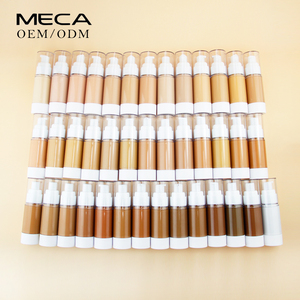
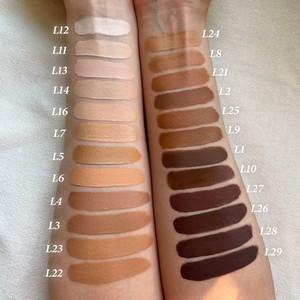
The era of 3-to-5 generic foundation shades is over. Brands competing globally require extensive shade ranges calibrated against the Fitzpatrick Skin Phototype Scale. Manufacturing a 40+ shade range—such as our No Logo 41 Colors Liquid Foundation Series—requires high-precision automated liquid dispensing systems to ensure color consistency across shade spectrums, from cool porcelain tones to deep warm undertones, without phase separation or undertone graying.
Consumers increasingly favor multi-benefit cosmetics that shorten morning routines. Formulating SPF15 to SPF50 broad-spectrum protection into a high-coverage liquid foundation requires overcoming emulsion whitening and greasiness. By utilizing micronized non-nano mineral filters combined with photostable organic boosters, our R&D team achieves high Sun Protection Factors (SPF) while maintaining a weightless, breathable, natural matte finish.
In the digital age driven by TikTok, Instagram, and fast-beauty trends, brand agility is vital. Traditional OEM minimum order quantities (MOQs) of 30,000 units per shade are prohibitive for indie brands and testing new market niches. Forward-thinking OEMs now offer tiered manufacturing options—enabling low MOQ entry runs (1,000 to 3,000 units) for stock chassis formulas with custom private label decoration, scaling into full custom formulation runs as sales volume expands.
Executing a successful private-label cosmetic product launch requires a structured engineering workflow. Below is an overview of our turnkey 6-stage OEM/ODM contract manufacturing process designed for global buyers:
Definition of target skin types, coverage level, finish (matte, dewy, satin), active ingredients, benchmark texture, and shade target profiles.
Cosmetic chemists formulate custom trial batches. Lab samples undergo sensory testing, viscosity calibration, and color shade matching for client approval.
Formulations undergo rigorous 90-day accelerated stability testing (45°C, freeze-thaw cycles, light exposure) and microbial challenge testing (PET).
Testing bulk formulas inside selected glass bottles, airless pumps, or squeeze tubes to ensure zero leaching, pump clogging, or vacuum degradation.
Vacuum emulsification in multi-ton reactors, automated inline shade blending, high-speed volumetric bottle filling, and robotic capping in cleanroom facilities.
Final batch Certificate of Analysis (COA) issuance, heavy metal and microbial clearance, container loading, and customs export documentation processing.
Get immediate answers to crucial questions regarding minimum order quantities, custom formulation development, regulatory documentation, and production lead times.
Our manufacturing facility offers flexible MOQ tiers. For standard stock formulas with private label logo printing, MOQs start as low as 1,000 units per shade. For 100% custom-developed formulas requiring unique active ingredients, custom shade development, or specialized primary packaging tooling, standard MOQs are typically 3,000 to 5,000 units per shade batch.
Yes. Our senior analytical chemists specialize in reverse engineering and formulation benchmarking. By providing a target market sample, our laboratory can analyze its rheology, particle size distribution, pigment ratio, and active composition to craft an equivalent or upgraded formula tailored to your brand's price point and clean-beauty targets.
We supply a complete regulatory dossier for global markets. Every export batch includes a Certificate of Analysis (COA), Safety Data Sheet (SDS / MSDS), Heavy Metal Test Report, Microbiological Limit Test Report, and Stability Test Data. For European markets, we assist with PIF (Product Information File) compilation and CPNP portal notification. For the US market, our facility is FDA registered and compliant with MoCRA requirements.
The typical timeline spans 4 to 8 weeks depending on custom requirements: 1) Initial Lab Sampling & Shade Matching: 7 to 10 days. 2) Stability & Compatibility Testing: 14 to 30 days (recommended for custom formulas). 3) Packaging Printing & Raw Material Sourcing: 15 to 20 days. 4) Mass Emulsification, Filling & Packaging: 15 days upon final sample approval.
Absolutely. We maintain strict ethical standards. All our foundation formulations are 100% cruelty-free and never tested on animals. We offer vegan certified formulations that contain zero animal lipids or by-products. Furthermore, our dedicated production lines possess Halal certification, adhering to strict sanitation, alcohol-free ingredient limits, and cross-contamination prevention guidelines.
We utilize advanced spectrophotometric computer color-matching systems (CIELAB scale) alongside standardized D65 lighting booths. During production, inline samples are tested against approved physical lab standards to ensure Delta-E (ΔE) color variance remains strictly below 0.5, guaranteeing flawless shade consistency from bottle to bottle and batch to batch.
Contact our R&D engineering team today to request sample kits, custom shade matching, or factory audit documentation.